Home » Sap Ing Sith — Secured Long-Term Property Rights in Thailand
“Sap Ing Sith” (ทรัพย์อิงสิทธิ) literally means “Right-Based Property.” It is a kind of property encumbrance that allows the holder to possess, use, and derive benefit from land or property as though they were the owner — for a maximum of 30 years — while the original owner retains title. Unlike a standard lease, this is not just a contract — it is a real right registered with the Land Department. It is particularly useful for long-term land use and is transferable to heirs.
It is frequently used in situations where outright ownership is prohibited, such as when a foreigner wants to secure land use in Thailand. With a valid title deed (Chanote), it can be applied to land, buildings, or both.
There are a number of legal steps that must be taken to make sure that a Sap Ing Sith agreement is valid and can be enforced. A written agreement between the grantee and the landowner must first spell out the terms of use. The title deed (Chanote) for the property must not have any legal problems or disputes. After that, the Land Department needs to officially register the agreement. Thai law will then recognize it as a real property right. Optional clauses about termination, transfer, or resale may also be added to protect the interests of both parties. Once it is registered, it is legally binding and stays with the land for the amount of time specified in the contract.
Foreigners are permitted to use and control land or property for a maximum of 30 years under Sap Ing Sith.
It can be passed on to heirs, unlike a typical lease or usufruct.
Compared to unregistered agreements or lease contracts, Sap Ing Sith is more protected and legally enforceable as a registered real property right.
It is available to foreigners for investment, business, or residential use.
Unlike leaseholds or usufructs, sap ing sith rights can be pledged as security or mortgaged.
With the landowner’s approval, the right may be sold, transferred, or assigned, giving foreigners choices in the event that their circumstances change or they want to recoup the value of the contract.
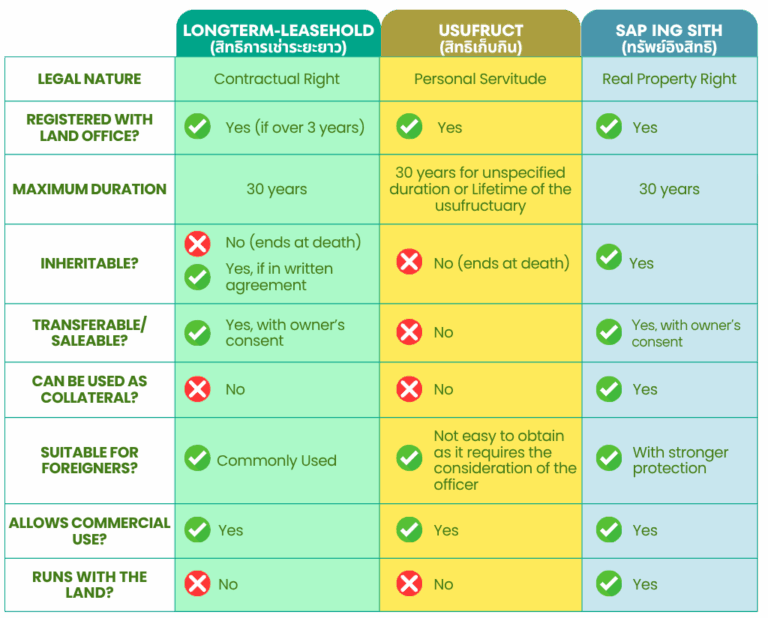
In Thailand, foreigners or non-landowners are constantly looking for legal ways to acquire long-term property rights. The three main options are leasehold, usufruct, and sap ing sith. Despite the fact that all three grant use rights, their strength, duration, legal effect, and transferability differ significantly.
Here’s a side-by-side comparison:
Every case is different. Whether you’re a foreigner investing in Thai property, a Thai national securing your family’s future, or a couple planning for retirement, we’ll help you choose the right legal structure — and register it properly.
Schedule a consultation to get personalized legal advice. We provide Sap Ing Sith registration services not only in Pattaya and the Eastern Seaboard but also in Bangkok and across other regions of Thailand. Wherever you are in the country, our team can guide you through the process to secure long-term property rights safely and efficiently.
Disclaimer: This information is intended as a general guide and does not replace personalized legal advice.
Licensed Attorney-At-Law | Licensed Notarial Services Attorney, The Lawyers Council of Thailand
Legal Counselor, Central Juvenile and Family Court
He also has extensive experience in conducting property due diligence and assisting clients with real estate transactions throughout Thailand.

Magna Carta Law Firm website uses cookies. Further details are set out in our Cookies Statement. Necessary cookies (essential to make our website work) are always on. You can adjust your preferences using the 'View preferences' button in the footer of our website.